
Possibility Is Not Multiplicity:
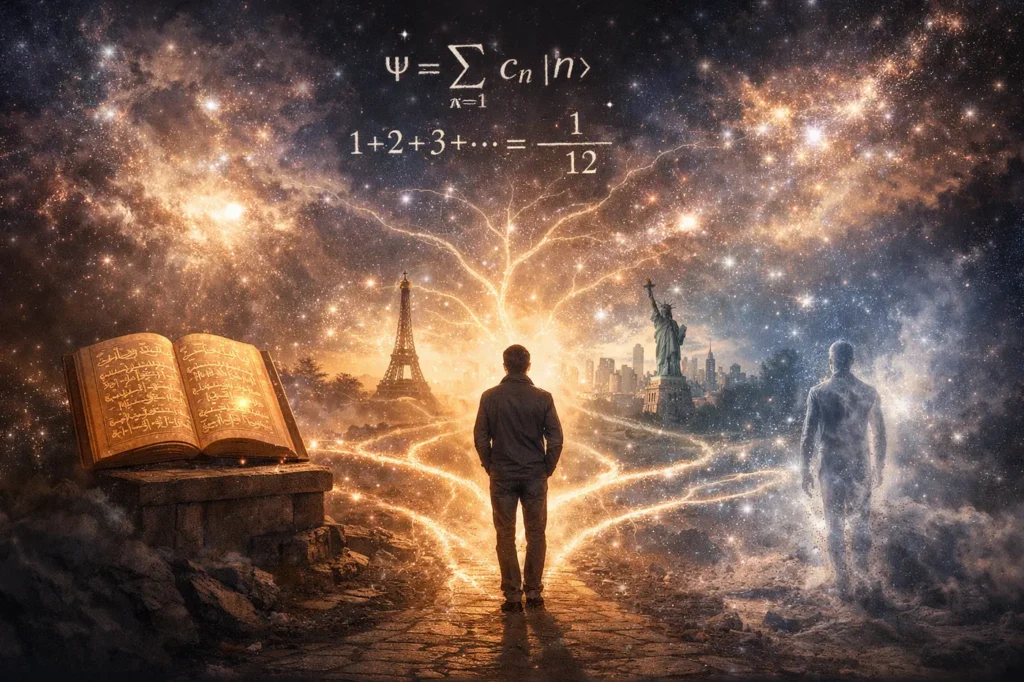
The notion that reality may branch into distinct lines of possibility, an idea articulated in quantum theory Hugh Everett III, was proposed as a solution to the problem of wave function collapse.
Its central claim is bold: every possible quantum outcome is physically realized in a separate, branching universe.
But a decisive philosophical question must be asked:
Does a mathematical description of probability require the physical realization of every possibility?
1. The Unjustified Leap: From Mathematics to Ontology
Quantum equations describe systems as superpositions of possible states. This is a mathematical representation of structured possibility.
However, moving from multiplicity in description to multiplicity in existence is a metaphysical leap not an experimental result.
The equation does not state that worlds multiply.
It states that outcomes are possible.
Confusing possibility with actuality is the core mistake.
2. Ontological Parsimony
If a phenomenon can be explained without positing an infinite proliferation of universes, then such proliferation becomes an unnecessary ontological expansion.
Explanations should not exceed necessity.
Many-Worlds is not a logical requirement.
It is an interpretive preference.
3. A Coherent Alternative: Structured Possibility, Singular Actuality
Reality can be conceived as a structured field of possibilities. All alternatives are real as possibilities but not all are actualized.
Within Islamic metaphysics, the concept of the Preserved Tablet affirms that divine knowledge encompasses every possible path and every outcome. Yet knowledge of a possibility does not necessitate its existence.
When a person chooses between two futures, a parallel universe does not emerge.
One path becomes actual. The other remains an unactualized possibility.
This preserves three constants:
Divine omniscience all possibilities are fully known.
Human freedom choice genuinely determines the realized path.
Ontological unity only one history becomes actual.
4. Freedom Does Not Require Cosmic Branching
If every possible choice is realized somewhere, then the meaning of decision weakens. Everything that can happen, happens.
In that case, choice does not determine destiny it merely determines which version of you experiences which outcome.
But if only one path becomes real, then choice is decisive, and responsibility is meaningful.
Conclusion
Possibility does not entail multiplicity.
Mathematical structure does not impose ontological inflation.
Divine knowledge does not require parallel worlds.
Human freedom does not require infinite copies of the self.
All possibilities exist as knowledge.
One alone becomes existence.