Parallel Universes and the Preserved Tablet:
A philosophical reflection at the intersection of quantum mechanics, determinism, and divine knowledge.
Quantum physics did something strange to our sense of reality.
It told us that the universe might not be singular.
According to the Many-Worlds Interpretation, first proposed by Hugh Everett in 1957, the wave function never collapses. Every quantum possibility unfolds. Every outcome happens. Reality does not choose it branches.
Somewhere, in another branch of the cosmos, you took the job.
In another, you didn’t.
In one, you were brave.
In another, you hesitated.
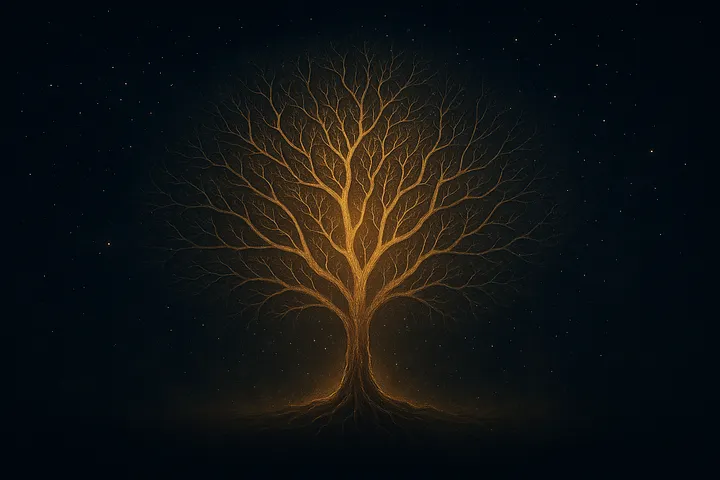
The idea is intoxicating. Infinite versions of you, scattered across a cosmic tree of decisions.
But here is the unsettling question:
If every possibility is realized somewhere, what makes this version of you morally meaningful?
If in some universe you acted with courage, and in another you failed which one carries responsibility? Which one is accountable?
Physics may allow branching.
But meaning demands selection.
And this is where an ancient theological idea enters the conversation not to compete with physics, but to reframe it.
In Islamic thought, there exists the concept of the Preserved Tablet a metaphysical record in which past, present, and future are known. Not merely events, but possibilities. Not merely outcomes, but all potential paths.
What if the “many worlds” are not physically unfolding realities but known possibilities within divine knowledge?
What if there are not countless active versions of you living elsewhere but countless potential versions that could have been?
The difference is subtle.
But philosophically, it is enormous.
In the multiverse, every branch is actual.
In divine omniscience, every branch is known but only one is chosen through your will.
That distinction preserves something physics struggles with: moral gravity.
Because if every action exists somewhere, then no action is ultimate.
But if only one path materializes the one you step into then existence regains its weight.
This does not erase freedom.
And it does not imply coercion.
Knowledge is not compulsion.
A teacher may know which student will fail but that knowledge does not cause the failure. It only reflects understanding of tendencies and choices.
Similarly, divine knowledge in this philosophical framing does not eliminate agency. It encompasses every possible decision you might take, and every consequence that would follow.
You do not move between universes.
You collapse possibility into reality through choice.
Every time you act, thousands of unrealized futures dissolve.
You are not a duplicate among duplicates.
You are a decisive moment.
And here emerges something even more profound: trust.
If you stand before an ocean of possibilities some leading to regret, others to growth, some to loss, some to transformation how do you choose?
Pure calculation fails.
Human foresight is limited.
But trust in a knowledge greater than your own becomes existential courage.
In Islamic spirituality, tawakkul (trust in God) is not passivity. It is not surrendering choice. It is choosing while recognizing that the One who sees the end of every branch knows what you cannot.
Sometimes the path appears harsh at its beginning.
Sometimes loss precedes expansion.
Sometimes difficulty hides refinement.
If all possibilities are known , then what appears painful may be protective.
What appears delayed may be merciful.
The multiverse proposes that every version of you exists.
But faith suggests something more demanding:
Only one version of you will stand accountable.
Only one life will crystallize.
Only one sequence of decisions will become your story.
Perhaps we are not drifting across infinite parallel selves.
Perhaps we are navigating a tree of potential collapsing it, moment by moment, into a singular moral narrative.
Not a copy.
Not a fragment.
But an entrusted consciousness walking one irreversible path.
And maybe the real question is not whether parallel universes exist.
But this:
If infinite possibilities surround you what makes this choice the one you are willing to own?
If every possibility exists somewhere, what makes this version of you morally accountable?